

“Robo-Tripping”: Dextromethorphan Overdose
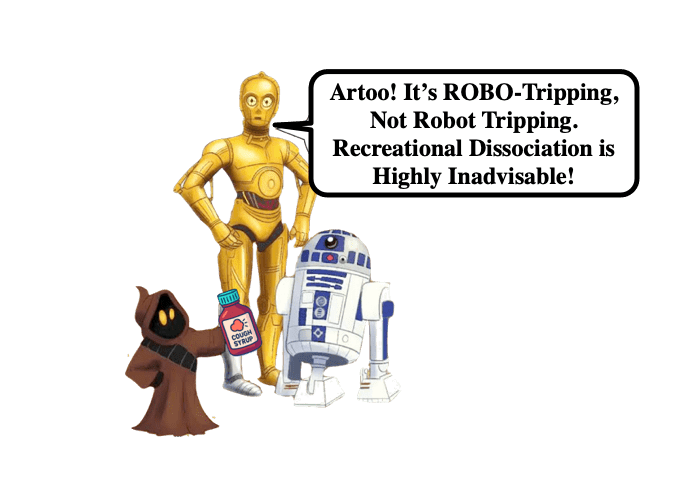
It’s always in the medicine cabinet and easily available over-the-counter; but that doesn’t necessarily mean it’s harmless. We typically try to avoid cough suppressants in children, but what happens when they get into it themselves (by accident or on purpose)? Dextromethorphan is not only the most common cough suppressant globally, it’s also the most recreationally abused over-the-counter drug worldwide [1]. With a wide-range of clinical symptoms and a side-effect profile that can mix and mimic nearly every toxidrome around town, let’s digest a morsel on what happens when others trip on that syrup – “Robo-Tripping” – Dextromethorphan Overdose:
Dextromethorphan Overdose: The Basics
Dextromethorphan (DXM) is a synthetic morphinan cough suppressant whose parent compound and active metabolite (dextrorphan) antagonize NMDA receptors
- Produces dissociative PCP-/ketamine-like effects at supratherapeutic doses: the basis for recreational “robo-tripping” [2-3]
- DXM is the perfect recipe for a classic adolescent drug of abuse:[4-5]
- Present in >140 OTC cough/cold products
- It is inexpensive
- Not detected on standard urine drug screens
- Carries no federal age restriction
Reassuringly, isolated DXM ingestions are rarely fatal; HOWEVER, most morbidity comes from:
- Co-formulated ingredients
- Massive doses, and/or
- In YOUNG CHILDREN, who are prone to a distinct cerebellar neurotoxicity syndrome called Dextromethorphan-Associated Neurotoxicity with Cerebellar Edema (DANCE) [4,6]
You not “hip”? Street names include (but certainly not limited to): Triple-C’s, Brownies, Skittles, Poor-Man’s Ecstasy/PCP/Lean, Red Devils, Robo, Velvet, Sky, Dextro, Tuss, and Sizzurp [7]
Dextromethorphan Overdose: Pharmacokinetics
At therapeutic doses DXM suppresses cough centrally and, unlike codeine, has no analgesic effect and does not cause respiratory depression [2]
- The metabolite dextrorphan (via CYP2D6) drives the dissociative/hallucinogenic effects
- CYP2D6 poor/ultra-rapid metabolizer status alters both euphoria and toxicity [3]
- The hydrobromide salt in chronic heavy users can cause bromism
- Bromism: psychosis, delirium, tremors, seizures, and acne-like rashes and painful skin growths [2]
DXM has serotonergic activity (serotonin reuptake inhibition) and can precipitate serotonin syndrome
- Particularly when combined with SSRIs, MAOIs, TCAs, meperidine, MDMA, lithium, tryptophan, or St. John’s wort [8]
- When able, collect collateral information and obtain common/notable co-ingestion labs
Recreational abuse is generally described above ~1500 mg/day
- Depending on age and weight, a max DXM dose is ~60-120 mg/day
- A life-threatening pediatric polistirex (Delsym XR) case involved 71.4 mg/kg
- Blood level of 110 ng/mL (therapeutic 10–40 ng/mL) [5,9]
Dextromethorphan Overdose: Presentation
DXM intoxication is classically dose-dependent, with users describe escalating “plateaus” from mild stimulation and euphoria to full dissociative anesthesia [2,6,9-10]
Key clinical findings from surveillance and case data:
- CNS: ataxia (single most common finding), lethargy, slurred speech, agitation, euphoria/dysphoria, hallucinations, paranoia, delirium, dystonia, stupor, coma, seizures
- Cardiovascular: tachycardia, hypertension, mydriasis
- GI: nausea and vomiting
- Ophthalmologic: nystagmus (including rotary), roving eye movements, blurred vision
- Dermatologic: flushing +/- urticarial rash (~18% of pediatric cases) and dystonia (~5%)
Severe/combination toxicity: hyperthermia, metabolic acidosis, respiratory depression, toxic psychosis, and coma are seen in severe toxicity and often when co-ingestants are present [4]
Dextromethorphan Overdose: Differential Diagnosis
Dextromethorphan produces a mixed dissociative/serotonergic/sympathomimetic picture!
Distinguish it from other toxidromes primarily by exam and history [11]:
- Serotoninergic toxidrome: Clonus, hyperreflexia, tremor, diaphoresis, hyperactive bowel sounds; rapid onset after serotonergic agents (can overlap with/be caused by DXM)
- Anticholinergic toxidrome: Mydriasis + dry mucosa, hot/dry/red skin, urinary retention, absent bowel sounds, normal reflexes (co-formulated antihistamines can add this picture)
- Sympathomimetic toxidrome: Diaphoresis, marked hypertension and tachycardia without dissociation or ataxia
- Phencyclidine/Ketamine intoxication: Nearly identical to dextromethorphan overdose (differentiate by history)!
- Opioid toxidrome: Miosis, respiratory depression
- Pediatric Opioid-Use Neurotoxicity with Cerebellar Edema (POUNCE) has near-identical clinical/radiologic findings to DANCE [12]
- Neuroleptic Malignant Syndrome: Slow onset, bradykinesia, lead-pipe rigidity, (history of dopamine antagonist exposure)
Dextromethorphan Overdose: DANCE Syndrome
Dextromethorphan-Associated Neurotoxicity with Cerebellar Edema (DANCE) occurs in young children <6 years of age (most commonly between 4 and 5) after ingesting DXM-containing cough syrup typically given for a viral illness (… don’t do this).
- Children present with sudden unresponsiveness/encephalopathy, and MRI shows cytotoxic, diffusion-restricting edema of the bilateral cerebellar hemispheres, sometimes with supratentorial white matter involvement — radiologically mirroring POUNCE [12-13]
- Prognosis is poor if unrecognized but favorable with prompt aggressive supportive care
Dextromethorphan Overdose Management
You guessed it… Supportive care!
- ABCs: protect the airway, support ventilation; intubate for coma or airway compromise
- Consult Poison Control and your Toxicology Team and screen for common co-ingestions
- Activated charcoal may be considered in large and/or recent ingestions in patients with protected airways, or with extended-release polistirex ingestions [5,8,10]
- Benzos for agitation, psychosis, delirium, seizures
- Diphenhydramine for any concerns of dystonia
- Suspected DANCE? Provide aggressive supportive/neurocritical care and obtain MRI brain as early as possible
- EM/Crit consideration: Emerging case-series experience suggests that IV methylprednisolone may improve neurologic outcomes in select cases, particularly when DANCE is recognized and treated early [12-13]
Moral of the Morsel
- It’s sneaky! Dextromethorphan is cheap, easy to get, and hard to detect, making it a favorite recreational drug for all patients (particularly adolescents).
- It’s serotonergic! Although DXM can mimic or muddy up some classic toxidromes, it can precipitate serotonin syndrome. Distinguish it from other toxidromes with a good history and physical exam
- It’s scary! Sudden unresponsiveness in a young child given cough syrup? Don’t forget DANCE! Provide aggressive supportive care and obtain MRI brain ASAP
Resources:
- Institute for Safe Medication Practices. Consumer MedSafety: https://www.consumermedsafety.org/over-the-counter-medicines/otc-drug-abuse/top-ten-otc-medicines-and-herbals-abused-by-teens-and-young-adults
- Lam SHF, Homme J, Avarello J, Heins A, Pauze D, Mace S, Dietrich A, Stoner M, Chumpitazi CE, Saidinejad M. Use of antitussive medications in acute cough in young children. J Am Coll Emerg Physicians Open. 2021 Jun 18;2(3):e12467. doi: 10.1002/emp2.12467. PMID: 34179887; PMCID: PMC8212563.
- McClure EW, Daniels RN. Classics in Chemical Neuroscience: Dextromethorphan (DXM). ACS Chem Neurosci. 2023 Jun 21;14(12):2256-2270. doi: 10.1021/acschemneuro.3c00088. Epub 2023 Jun 8. PMID: 37290117.
- Ontiveros S, Cantrell L. Fatal cold medication poisoning in an adolescent. Am J Emerg Med. 2022 Feb;52:269.e1-269.e2. doi: 10.1016/j.ajem.2021.08.043. Epub 2021 Aug 21. PMID: 34454805.
- Martinak B, Bolis RA, Black JR, Fargason RE, Birur B. Dextromethorphan in Cough Syrup: The Poor Man’s Psychosis. Psychopharmacol Bull. 2017 Sep 15;47(4):59-63. doi: 10.64719/pb.4553. PMID: 28936010; PMCID: PMC5601090.
- Paul IM, Reynolds KM, Kauffman RE, Banner W, Bond GR, Palmer RB, Burnham RI, Green JL. Adverse events associated with pediatric exposures to dextromethorphan. Clin Toxicol (Phila). 2017 Jan;55(1):25-32. doi: 10.1080/15563650.2016.1240803. Epub 2016 Oct 13. PMID: 27736263.
- Health Encyclopedia, University of Rochester Medicine: https://www.urmc.rochester.edu/encyclopedia/content?contenttypeid=1&contentid=2261
- Chyka PA, Erdman AR, Manoguerra AS, Christianson G, Booze LL, Nelson LS, Woolf AD, Cobaugh DJ, Caravati EM, Scharman EJ, Troutman WG; American Assiciation of Poison Control Centers. Dextromethorphan poisoning: an evidence-based consensus guideline for out-of-hospital management. Clin Toxicol (Phila). 2007 Sep;45(6):662-77. doi: 10.1080/15563650701606443. PMID: 17849242.
- Seltzer JA, Sheth SK, Friedland S, Foreman E, Toney C, Raviendran R, McDaniel MA, Lasoff DR. Life-threatening pediatric dextromethorphan polistirex overdose. Am J Emerg Med. 2022 Nov;61:233.e1-233.e2. doi: 10.1016/j.ajem.2022.08.006. Epub 2022 Aug 8. PMID: 35989201.
- Stanciu CN, Penders TM, Rouse EM. Recreational use of dextromethorphan, “Robotripping”-A brief review. Am J Addict. 2016 Aug;25(5):374-7. doi: 10.1111/ajad.12389. Epub 2016 Jun 11. PMID: 27288091.
- Dutta S, Buciuc AG, Barry P, Padilla V. A Narrative Review on Toxidromes in the Psychiatric Population: Implications for Overdose Prevention. J Clin Med. 2025 Aug 31;14(17):6160. doi: 10.3390/jcm14176160. PMID: 40943922; PMCID: PMC12429776.
- Sharma S, Tiwari S, Saini L, Yadav T, Manjunathan S, Panda A, Choudhary B, Khera D. Dextromethorphan-Associated Neurotoxicity with Cerebellar Edema Syndrome in Young Children: Neuroimaging Features. AJNR Am J Neuroradiol. 2025 Feb 3;46(2):390-394. doi: 10.3174/ajnr.A8455. PMID: 39151957; PMCID: PMC11878978.
- Angurana SK, Manjunathan S, Suthar R, Samynathan P, Uppaluri PB, Raj S, Saini AG. Dextromethorphan-associated neurotoxicity with cerebellar edema (DANCE) syndrome. Clin Toxicol (Phila). 2026 Aug 6:1-4. doi: 10.1080/15563650.2026.2707982. Epub ahead of print. PMID: 42560973.
Author