


Torticollis

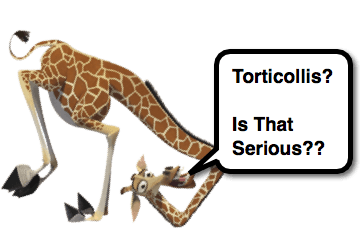 Neck problems will often grab our attention. Since the neck connects the head to the rest of the body, it seems reasonable that we pay particular attention to neck issues. Many issues are common and often benign, like “sore throat” (ex, Strep pharyngitis, Mono). Other issues can be much more ominous, like “pain in neck” (ex, C-spine clearance, Retropharyngeal abscess). Another that will definitely attract attention is a “twisted neck.” Let us consider Torticollis.
Torticollis: Basics
- “Torticollis” refers to:
- Ipsilateral head tilt with contralateral rotation. [Suhr, 2015]
- Ipsilateral ear is tilted toward shoulder and chin is turned in opposite direction [Tumturk, 2015]
- Torticollis is not a diagnosis.
- It is a symptom. (Similar to ALTE, which is also not a real diagnosis).
- Our job is to consider the cause!
- Often considered in two broad categories:
- Congenital (seen in neonates and infants)
- Acquired (seen in older children)
Torticollis: Causes and Considerations
- Many conditions can lead to torticollis and they range from benign to life-threatening. [Tumturk, 2015]
- Congenital Torticollis
- Muscular (ex, Congenital Muscular Toricollis)
- Bone (ex, Occipitoatlantal fusion or atlas/axis anomalies)
- CNS (ex, Syringomyelia, ocular abnormalities)
- Other (ex, Skin thickening, ligamentous laxity)
- Acquired Torticollis
- Trauma (ex, fractures, dislocations, muscle spasm)
- Infection (ex, Retropharyngeal abscess, mastoiditis, epidural abscess, meningitis, osteomyelitis/diskitis)
- Neoplasm (ex, CNS tumors, spine/skull tumors) [Tumturk, 2015]
- Ocular (ex, strabismus leading to corrective head tilt)
- Drug adverse effect (ex, dystonia)
- Other (ex, Juvenile idiopathic arthritis, Sandifer syndrome, Down syndrome)
Torticollis: Congenital Muscular Torticollis
- Seen in neonates and infants.
- Most common cause of torticollis.
- It is 3rd most common pediatric musculoskeletal deformity. [Nichter, 2015]
- Hip Dysplasia and talipes equinovarus are more common.
- Thought to be due to:
- Birth trauma
- Intrauterine position
- Actual cause is not known.
- Characterized by fibrosis of the sternocleidomastoid muscle.
- Early recognition is vital for initiation of appropriate therapy and prevention of secondary sequelae. [Nichter, 2015]
- Associated with plagiocephaly and developmental delays.
- Therapy by 2.5 months of life leads to superior outcomes compared to those identified later.
- Delays in diagnosis lead to increase in costs and services. [Nichter, 2015]
- RED FLAGS: [Nichter, 2015]
- Patients with red flags need more urgent referral back to primary care provider and physical therapy.
- Head and neck asymmetry
- C-spine limited passive range of motion
- Skeletal abnormalities
- Palpable masses of neck
- CNS dysfunction
- Patients with red flags need more urgent referral back to primary care provider and physical therapy.
- May also benefit for imaging.
- Ultrasound is preferred initially. [Haque, 2012]
- U/S of the sternocleidomastoid muscle can identify tumor or fibrous changes.
- Conventional radiography would be preferred if suspicion is present for craniovertebral abnormalities. [Haque, 2012]
- Ultrasound is preferred initially. [Haque, 2012]
Moral of the Morsel
- Torticollis is not a diagnosis, it is a symptom and, as such, should lead us to question the etiology.
- Torticollis in neonates and infants may be benign, but look for the Red Flags.
- Image if Red Flags are present.
- If no Red Flags are present, instruct on passive range of motion exercises and ensure close follow-up with PMD to monitor for improvement and complications develop.
- Even if you think it is “just a muscle spasm,” there can be real consequences and deserves close follow-up.
- For acquired torticollis, be concerned for an underlying life-threatening condition. [Tumturk, 2015]
- History and examination are imperative to help determine best imaging modality. [Tumturk, 2015; Haque, 2012]
References
Tumturk A1, Kaya Ozcora G, Kacar Bayram A, Kabaklioglu M, Doganay S, Canpolat M, Gumus H, Kumandas S, Unal E, Kurtsoy A, Per H. Torticollis in children: an alert symptom not to be turned away. Childs Nerv Syst. 2015 Sep;31(9):1461-70. PMID: 26043711. [PubMed] [Read by QxMD]
Suhr MC1, Oledzka M. Considerations and intervention in congenital muscular torticollis. Curr Opin Pediatr. 2015 Feb;27(1):75-81. PMID: 25565573. [PubMed] [Read by QxMD]
Nichter S1. A Clinical Algorithm for Early Identification and Intervention of Cervical Muscular Torticollis. Clin Pediatr (Phila). 2015 Aug 24. PMID: 26307184. [PubMed] [Read by QxMD]
Haque S1, Bilal Shafi BB, Kaleem M. Imaging of torticollis in children. Radiographics. 2012 Mar-Apr;32(2):557-71. PMID: 22411949. [PubMed] [Read by QxMD]
Do TT1. Congenital muscular torticollis: current concepts and review of treatment. Curr Opin Pediatr. 2006 Feb;18(1):26-9. PMID: 16470158. [PubMed] [Read by QxMD]
Author


[…] in their own necks. We have addressed several potential causes of the neck pain previously (ex, Torticollis, Strep Pharyngitis, Peritonsillar Abscess, Retropharyngeal Abscess, Lymphadenopathy, […]