


Pediatric Penetrating Neck Injury

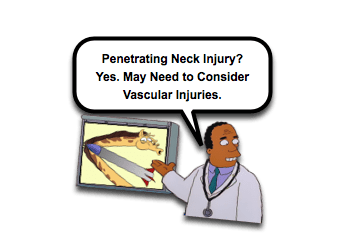 A child’s neck, naturally, is a special region of their body. It has numerous vital and delicate structures crammed in closely together. Neck complaints, therefore, warrant our vigilance (ex, Neck Mass, Torticollis, Retropharyngeal Abscess), particularly when the come in the setting of trauma. Often we discuss potential concerns for cervical spine (c-spine) injuries (ex, Sports Related), but there are other issues to consider when sharp and fast moving objects impact the neck. Let us digest a Morsel of information about the Pediatric Penetrating Neck Injury:
Penetrating Neck Injury: Basics
- Mortality rate found to be lesser than in adults (~5.6% vs 11%). [Stone, 2016]
- Hypotension upon presentation and vascular injury were independent predictors of mortality.
- Fortunately, penetrating neck injury is rare in children. [Stone, 2016]
- Very rare in civilian settings (although, it only takes one projective to change that for one child).
- Overall incidence was < 0.3% for years 2008-2012.
- Aerodigestive injuries are more common than vascular (21.5% vs 16.5%).
- Aerodigestive injuries most commonly occurred in younger children (0-5 years).
- Smaller area containing some amount of sensitive structures, likely explains this difference.
- All other injuries (vascular, bony, and nerve) were more commonly seen in older children.
- Older children are more likely to be involved in more violent encounters and accidents.
- Stabbing accounts for ~44% of cases (Firearms account for ~24% of cases).
- Firearm related – incidence increases as age increases (0-5 < 6-10 < 11-15 years)
- Neck Zones
- Classically described and used to discuss possible management.
- Management / evaluation of adult penetrating neck injury has evolved. [Vick, 2008]
- Immediate surgical exploration is reserved for those with concerning clinical scenarios/signs.
- May may be less useful in determining management, but still used to describe locations
- Zone 3 – Superior to the angle of the mandible
- Zone 2 – Between the angle of the mandible and the cricothyroid membrane
- Zone 1 – Below the cricothyroid membrane
- Classically described and used to discuss possible management.
Penetrating Neck Injury: Hard and Soft Signs
- Soft Signs of Injury
- Hoarseness
- Dysphagia
- Odynophagia
- Palpable crepitus
- Stable hematoma
- Neurologic change
- Hard Signs of Injury
- Active Hemorrhaging – 1 of the most common hard signs [Tessler, 2017]
- Airway Compromise – 1 of the most common hard signs [Tessler, 2017]
- Respiratory Distress
- Pulsatile/Expanding Hematoma
- Pulse Deficit
- Massive Subcutaneous Emphysema
- Shock – Hypotension develops late in children… other signs are usually present beforehand. [Tessler, 2017]
Penetrating Neck Injury: Evaluation
- As the evaluation of adult penetrating neck injury has evolved, so too has the evaluation of pediatric penetrating neck injury. [Tessler, 2017; Prichayudh, 2015; Tisherman, 2008; ]
- Neck exploration is particularly challenging in children.
- Neck exploration may cause further injury.
- Endoscopy and angiography are also more challenging in children.
- IMMEDIATE surgical exploration is usually not required in most children. [Stone, 2016; Hackett, 2012; Vick, 2008; Kim, 2000]
- Consider avoiding immediate surgery if:
- Clinically stable.
- No hard signs of significant injury.
- Hard signs are similarly reliable in children as in adults. [Tessler, 2017]
- Presence of hard signs should warrant emergent surgery.
- They may also require emergent stabilization.
- Zone 1 and Zone 3 are more difficult to control with direct pressure.
- Proceed with airway management early!
- Selective surgical exploration may be useful for some patients with some soft signs. [Kim, 2000]
- Stridor, dysphagia, changing neck examination, and obvious retained foreign body have been proposed as reasons to proceed to the OR.
- Selective surgical exploration compliments close observation.
- Consider avoiding immediate surgery if:
- In addition to physical exam, CT Angio of the neck (and chest for Zone 1 injuries) has evolved to be the preferred evaluation tool. [Tessler, 2017; Stone 2016; Vick, 2008]
- Bronchoscopy and endoscopy may be required, but with improved imaging, are not mandatory.
- Imaging may help reduce nontherapeutic surgical exploration and other procedures.
Moral of the Morsel
- Know your Zones… but Management is not dependent upon them. Zone 2 injury does not equate to immediate surgical exploration in children.
- Know your Hard and Soft Signs. If no hard signs, may still benefit from surgery if soft signs amass or exam is worsening.
- Be vigilant… anticipate the airway being challenging and getting progressively worse.
References
Tessler RA1, Nguyen H, Newton C, Betts J. Pediatric penetrating neck trauma: Hard signs of injury and selective neck exploration. J Trauma Acute Care Surg. 2017 Jun;82(6):989-994. PMID: 28521330. [PubMed] [Read by QxMD]
Stone ME Jr1, Farber BA, Olorunfemi O, Kalata S, Meltzer JA, Chao E, Reddy SH, Teperman S. Penetrating neck trauma in children: An uncommon entity described using the National Trauma Data Bank. J Trauma Acute Care Surg. 2016 Apr;80(4):604-9. PMID: 26808024. [PubMed] [Read by QxMD]
Prichayudh S1, Choadrachata-anun J2, Sriussadaporn S2, Pak-art R2, Sriussadaporn S2, Kritayakirana K2, Samorn P2. Selective management of penetrating neck injuries using “no zone” approach. Injury. 2015 Sep;46(9):1720-5. PMID: 26117413. [PubMed] [Read by QxMD]
Hackett AM1, Chi D, Kitsko DJ. Patterns of injury and otolaryngology intervention in pediatric neck trauma. Int J Pediatr Otorhinolaryngol. 2012 Dec;76(12):1751-4. PMID: 22959737. [PubMed] [Read by QxMD]
Tisherman SA1, Bokhari F, Collier B, Cumming J, Ebert J, Holevar M, Kurek S, Leon S, Rhee P. Clinical practice guideline: penetrating zone II neck trauma. J Trauma. 2008 May;64(5):1392-405. PMID: 18469667. [PubMed] [Read by QxMD]
Vick LR1, Islam S. Adding insult to injury: neck exploration for penetrating pediatric neck trauma. Am Surg. 2008 Nov;74(11):1104-6. PMID: 19062670. [PubMed] [Read by QxMD]
Abujamra L1, Joseph MM. Penetrating neck injuries in children: a retrospective review. Pediatr Emerg Care. 2003 Oct;19(5):308-13. PMID: 14578829. [PubMed] [Read by QxMD]
Kim MK1, Buckman R, Szeremeta W. Penetrating neck trauma in children: an urban hospital’s experience. Otolaryngol Head Neck Surg. 2000 Oct;123(4):439-43. PMID: 11020182. [PubMed] [Read by QxMD]
Author


[…] what happens when one patient complains of both issues? Could it be a Cervical Spine Injury or Penetrating Neck Trauma? Perhaps, but let us not overlook the traumatic blow to the anterior neck (the hip kids today talk […]