

Adenovirus Infections in Children
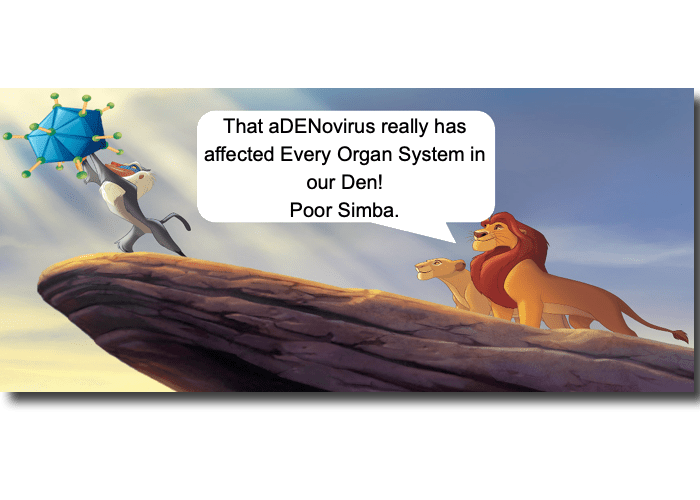
So much of what we see in the pediatric emergency department is “just a virus.” These kiddos, big and small, are going through their first few chapters of life and getting knocked in the teeth by all sorts of bugs for the first time. While viral infections are often an annoyance, they can still lead to chaos and consequences! We have a good idea of common presentations for viruses such as Mumps, Influenza, and even Measles, but there is one virus that can look like, well, basically everything. Let’s take a moment and enter the lion’s DEN to indulge in another tasty morsel about a virus that simply refuses to stay in its lane: aDENovirus.
Adenovirus: The Basics
- Adenovirus is a double-stranded DNA virus that causes a wide range of clinical symptoms from snotty sniffles to disseminated ICU-level chaos
- Adenovirus does not follow a seasonal pattern and is prevalent year-round [1]
- Infections occur worldwide and affect individuals of all ages, with higher burden in neonates, young children, and the immunocompromised
- Part of the Adenoviridae family and Mastadenovirus genus, there are more than 100 serotypes grouped into seven subspecies (A-G), each responsible for distinct clinical syndromes [1,3]
- Respiratory disease: Types 1–5, 7, 14, 21, 55
- Severe respiratory infections: Types 3, 7, 14
- Epidemic keratoconjunctivitis: Types 8, 37, 53, 54, 64
- Gastroenteritis: Types 40, 41
- Transmission occurs via respiratory droplets, direct contact or fomites, and fecal-oral
- Highly transmissible: daycares, military facilities, college dorms, hospitals, and transplant units
- Community outbreaks of adenovirus-associated pharyngoconjunctival fever have been attributed to water exposure from contaminated swimming pools [1-2]
Adenovirus Presentation: The Clinical Chameleon
- Adenovirus doesn’t pick a system… it picks all of them.
- Common Things are Common – Adenovirus is known to cause [2,4]:
- URI (pharyngitis, tonsillitis, coryza)
- Follicular conjunctivitis / Keratoconjunctivitis
- Otitis media
- Gastroenteritis
- Croup
- Bronchiolitis
- Fever greater than >104°F, and lasting longer than 5 days
- Less commonly, but typical of Adenovirus – Think severe cases and disseminated disease [4]:
- Hemorrhagic cystitis
- Pneumonia
- Bronchiolitis obliterans
- Seizures
- Meningitis / Encephalitis
- Hepatitis
- Myocarditis / Pericarditis / Cardiomyopathy
- High-risk players:
- Neonates
- Immunocompromised (transplant, oncology, etc.)
Adenovirus: Diagnostic Approach
Testing is not routinely required for mild disease but can be considered in:
- Severe illness (hospitalization, ICU-level care)
- High-risk populations
- Outbreak settings
- Screenings of high-risk transplant populations or in patients with prolonged fever >7 days (practice varies)
Preferred Diagnostic Modality: PCR
- Polymerase chain reaction is the gold standard due to high sensitivity and specificity
- Specimen selection typically varies by syndrome:
- URI or Conjunctivitis: Nasopharyngeal/throat swab or conjunctival swab
- Gastroenteritis: Stool
- Hemorrhagic cystitis: Urine
- Pneumonia: BAL, sputum, tracheal aspirate
- Meningitis/Encephalitis: CSF
- Hepatitis/Myocarditis: Blood or tissue
(As always) If you are going to test, know what to do with the results!
- Negative PCR: Generally rules out infection at respective site
- Positive PCR: Must be interpreted cautiously due to:
- Prolonged viral shedding and symptomatic carriage (especially stool, upper respiratory tract)
- Key distinctions:
- Blood viral load: Rising/high levels → concern for invasive disease
- Tissue/CSF PCR: Indicates true active infection
Adenovirus: Management
Like nearly all viruses the management of Adenovirus is supportive care
- Oral +/- IV fluids (re)hydration, antipyretics, and analgesics
- Tender loving care
Most infections in immunocompetent patients are self-limited
- In certain cases of severe illness or in immunocompromised individuals anti-virals may play a role
- Cidofovir is the most commonly used agent, though there is major concern for nephrotoxicity and myelosuppression [1]
- Other alternative therapies include brincidofovir, topical ganciclovir (ocular disease), and ribavirin
- These medications typically have limited availability, limited roles, and inconsistent benefits
Adenovirus Vaccination
- It exists! A live oral vaccine (protective against serotypes 4 and 7) has only been approved for military personnel ages 17 years to 50 years [1,5]
- Adenovirus vaccination has been highly effective in preventing community outbreaks in these populations
Moral of the Morsel:
- Everything is Adenovirus! Adenovirus causes a broad spectrum of disease, from mild URI to fatal disseminated infection
- The Kawasaki Imitator! Adenovirus is known to cause prolonged fever for up 5 to 7 days with a lot of the same C.R.A.S.H. and BURN signs and symptoms
- Conjunctivitis or Chlorine? Community and home pool exposure can be a source of adenovirus induced pharyngoconjunctival fever
- Wash Yo’ Hands! Infection control is critical due to environmental persistence and outbreak potential
References
- “Adenovirus Infections”, Red Book: 2024–2027 Report of the Committee on Infectious Diseases, Committee on Infectious Diseases, American Academy of Pediatrics, David W. Kimberlin, MD, FAAP, Ritu Banerjee, MD, PhD, FAAP, Elizabeth D. Barnett, MD, FAAP, Ruth Lynfield, MD, FAAP, Mark H. Sawyer, MD, FAAP
- “Adenovirus Infections”, American Academy of Pediatrics. American Academy of Pediatrics Section on Infectious Diseases. June 2022. William Otto, MD, FAAP
- Greber, U.F. (2020), Adenoviruses – Infection, pathogenesis and therapy. FEBS Lett, 594: 1818-1827.
- Shieh WJ. Human adenovirus infections in pediatric population – An update on clinico-pathologic correlation. Biomed J. 2022 Feb;45(1):38-49. doi: 10.1016/j.bj.2021.08.009. Epub 2021 Sep 10. PMID: 34506970; PMCID: PMC9133246.
- Lyons A, Longfield J, Kuschner R, Straight T, Binn L, Seriwatana J, Reitstetter R, Froh IB, Craft D, McNabb K, Russell K, Metzgar D, Liss A, Sun X, Towle A, Sun W. A double-blind, placebo-controlled study of the safety and immunogenicity of live, oral type 4 and type 7 adenovirus vaccines in adults. Vaccine. 2008 Jun 2;26(23):2890-8. doi: 10.1016/j.vaccine.2008.03.037. Epub 2008 Apr 10. PMID: 18448211.
Author