


Pulmonary Embolism in Children: BEEPER Study

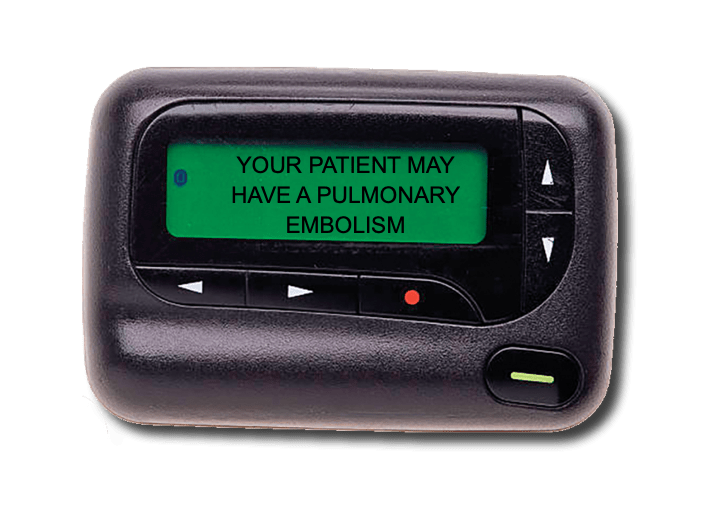
“Back in da day” we used Beepers to communicate. Archaic? Sure. Cumbersome to have to return the page? Absolutely, … but it did led to actual conversations between people (isn’t it nice to actually talk to people?!). Around the time that the first iPhone was replacing our beloved beepers (2007), the very first PedEMMorsels were being written (of course, back then they were part of UMEM Pearls). Over the course of the past decade and a half, the Morsels have covered many “adult conditions” that can also affect children (ex, cholecystitis, nephrolithiasis, a-fib, DVT, and even Variceal Bleeds). One other condition that was covered, but deserves some new consideration is Pulmonary Embolism. Similar to the Beepers of the past, our understanding of Pulmonary Embolism is in need of updating! Fortunately for us, our PECARN friends have endeavored to expand our understanding of pulmonary embolism in children and its evaluation in the ED. Let’s take a minute to digest a new Morsel on their recent publication on Pulmonary Embolism in Children: The BEEPER Study!
Pulmonary Embolism in Children: Basics
- It is uncommon, but does occur
- Occurs in < 1 in 20,000 children (<18 years of age) in general
- National Hospital Discharge Survey – 0.9 / 100,000 hospitalized children per year
- Venous thromboembolism rates have increased over the past 2 decades. [Boulet, 2012; Raffini, 2009]
- Increase use of intravascular devices (ex, central lines, PICC lines) have increased number of patients at risk
- The risk-stratification tools that are used for adults have not been validated for children.
- Wells Criteria – not validated in children
- PERC (Pulmonary Embolism Rule-out Criteria) – Adult version not validated in children …
Enter the BEEPER study – the first prospective validation of the PERC-Peds rule to determine whether it can safely identify children at very low risk who do not need further testing.
Pulmonary Embolism in Children: PERC-Peds?
- 8 Clinical Criteria:
- Clinician gestalt <15%
- No prior PE/DVT
- No surgery requiring intubation in previous 30 days
- No estrogen use
- No hemoptysis
- Age-adjusted heart rate normal
- < 120 bpm for children 12 or younger
- < 100 bpm for children >12 years of age
- Oxygen saturation >94%
- No suspected DVT
- Negative only if all eight criteria are met
- If any criteria is met, then the rule will not exclude the presence of pulmonary embolism
- This does NOT mean that those with + PERC-Peds need to have a chest CT
- Similar to the PECARN minor head injury rule… it helps determine who is LOW-Risk and do NOT need additional testing
Pulmonary Embolism in Children: BEEPER Study
BEEPER = Bedside Exclusion of Pulmonary Embolism without Radiation in Children
What Did They Do?
- Prospective multicenter observational diagnostic accuracy study at 21 US pediatric EDs.
- Diagnostic utility of PERC-Peds and
- Also the first large prospective pediatric evaluation of D-dimer performance in PE
- Included children 4-17 years old in whom PE was tested for or seriously considered
- 4039 enrolled, 4011 adjudicated, 3988 with complete data
- Median age 15 years
- Outcome was PE or proximal DVT within 45 days
- PE/proximal DVT prevalence was 6.3%
Key Results
- Sensitivity 99.6%
- Specificity 19.6%
- NPV 99.9%
- False-negative rate 0.1%
- Only one PERC-Peds negative patient had PE
D-Dimer Impact
- D-Dimer threshold of 500 ng/mL
- D-dimer alone had sensitivity 89.8%
- Sequential PERC-Peds then (if failed PERC-Peds) application of D-dimer ruled out VTE in 54.3% of patients with a false-negative rate of 0.9%
Impact on CT Use
- PERC-Peds alone could have avoided about 8% of CTs
- A PERC-Peds plus D-dimer strategy may reduce CT use by approximately 20%
Limitations
- Observational design
- Primarily academic pediatric EDs
- Low specificity (but also not the point of the tool)
- Moderate inter-rater reliability for gestalt
- Not intended for hospitalized children
Moral of the Morsel
- Check your BEEPER! No… no one is paging you on it… but using the PERC-Peds rule can help identify a set of pediatric patients who are low-risk for having pulmonary embolism.
- You matter! Your Clinician gestalt is essential in the assessment of the risk for the patient having a pulmonary embolism.
- PERC-Peds First… D-Dimer maybe! If all 8 criteria are not met, then consider D-Dimer to help further risk-stratify your patient.
- PECARN is Prodigious!! I anticipate more profound findings with respect to the characteristics that do increase a pediatric patient’s risk for pulmonary embolism. BEEPER was the first major step… but there are others to follow. Stay tuned (and stay vigilant)!
Bottom Line
Among children aged 4-17 years evaluated for possible PE, PERC-Peds demonstrated excellent sensitivity and a miss rate of only 0.1%, supporting its use as a bedside tool to avoid unnecessary testing.
References
Ellison AM, Kuppermann N, Shihabuddin BS, Hickingbotham H, Cator A, Lubell TR, Hoehn E, O’Connell KJ, Spencer S, Chumpitazi CE, Hennelly K, Kaplan R, Eisenberg MA, Powell EC, Mercurio L, Riney LC, Johnson TJ, Johnson MD, Bogie A, Schultz M, Mendelson J, DeLaroche AM, Race J, Casper TC, Kline JA. PERC-Peds rule for bedside exclusion of pulmonary embolism without radiation in children in the USA (BEEPER): a multicentre, prospective, observational, diagnostic accuracy study. Lancet Respir Med. 2026 Aug;14(8):694-703. doi: 10.1016/S2213-2600(26)00086-X. Epub 2026 Jul 3. PMID: 42398511.
Boulet SL, Grosse SD, Thornburg CD, Yusuf H, Tsai J, Hooper WC. Trends in venous thromboembolism-related hospitalizations, 1994-2009. Pediatrics. 2012 Oct;130(4):e812-20. doi: 10.1542/peds.2012-0267. Epub 2012 Sep 17. PMID: 22987875; PMCID: PMC4527304.
Raffini L, Huang YS, Witmer C, Feudtner C. Dramatic increase in venous thromboembolism in children’s hospitals in the United States from 2001 to 2007. Pediatrics. 2009 Oct;124(4):1001-8. doi: 10.1542/peds.2009-0768. Epub 2009 Sep 7. PMID: 19736261.
Author

