


B-Type Natriuretic Peptide (BNP) use in Children

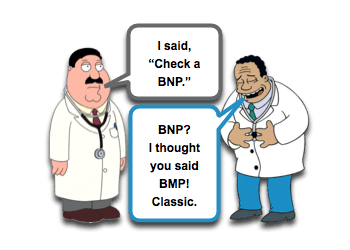 We doctors love to order tests, often only to confirm things we already know. Did that lactate level for the child in SHOCK help your decision to start vasopressors? Better yet, did that WBC count really help us determine whether the child with fever has a bacterial infection? Yet, there are times when our clinical assessment can still leave us struggling to decide between two significant entities: like respiratory distress due to heart failure or pulmonary disease. In adults, we often us the B-Type Natriuretic Peptide (BNP) to help us distinguish between these two issues, but can we use the BNP in children? Let us review the BNP use in children:
BNP: Basics
- B-Type Natriuretic Peptide (BNP): [Neves, 2016]
- Is derived from proBNP which is cleaved into biologically inactive NT-proBNP and proBNP (typically referred to as BNP), which is biologically active.
- Has a half life of 15-20 min (versus NT-proBNP with half life of 1-2 hours)
- Testing results vary between different immunoassay methods.
- The active segment of BNP: [Neves, 2016]
- Has natriuretic, vasodilatory, and diuretic effects.
- Counteracts the renin-angiotensin-aldosterone and sympathetic nervous systems.
- BNP is released from ventricular myocardium in response to wall stress due conditions that lead to: [Neves, 2016]
- Increased Preload
- Increased Afterload
- Decreased Systolic Ventricular Function
- Decreased Diastolic Ventricular Function
- While we often think of BNP as being related to heart failure, it can be elevated for a variety of reasons, including:
- Liver failure
- Renal impairment (although, BNP can still serve as a marker of heart strain in these patients) [Rinat, 2012]
- Hemodynamically significant pulmonary emboli
- Cor pulmonale
- Inflammatory diseases
BNP: Age Matters
BNP / NT-proBNP levels are influenced by the patient’s age (come on people, it’s pediatrics… of course the age matters)
- In the ED, if there is clinical suspicion for cardiovascular disease, the current described discriminatory levels are: [Cantinotti, 2014; Law, 2009; Maher, 2008]
- For 1st week of life – cutoff of 170 pg/mL (Sen- 94%; Spec- 73%)
- Older infants and children (up to 19 years) – cutoff of 41 pg/mL (Sen- 87%; Spec- 70%)
- Below the discriminatory level, the presentation is not likely related to cardiovascular etiology (thus, more likely related to something like Bronchiolitis). [Maher, 2008]
- Levels are most elevated in the first 3-4 days of life: [Neves, 2016; Cantinotti, 2014; Law, 2009; Maher, 2008]
- Potentially to help with natriuresis and reduction of pulmonary vascular resistance.
- Additionally, kidneys are more immature and after load increases.
- Levels fall throughout first month of life. [Neves, 2016; Cantinotti, 2014]
- From 1 month of age to ~12 years of age, BNP levels remain relatively stable in healthy individuals. [Neves, 2016; Cantinotti, 2014]
- After puberty, levels can increase toward adult levels and are higher in females than males. [Neves, 2016]
BNP: Uses in Children
Diagnosis of newly developed heart failure in children is very challenging as it often initially presents with subtle and non-specific findings.
- BNP / NT-proBNP levels, in the clinical setting of suspicion for possible heart failure, have been shown to be valuable.
- Improves the diagnostic accuracy in the evaluation of heart disease in children. [Neves, 2016; Cantinotti, 2014; Maher, 2008]
- Increase the accuracy of neonatal screening for Congenital Heart Disease. [Neves, 2016; Cantinotti, 2014]
- BNP / NT-proBNP levels can also be used to evaluate patients with known heart failure and monitor the effectiveness of therapies and need for surgery. [Neves, 2016; Cantinotti, 2015; Cantinotti, 2014; Auerbach, 2010]
- BNP levels need to be assessed based on specific commercial assay (cannot compare different assays’ levels). NT-proBNP measurements are not affected by different assays though. [Cantinotti, 2014]
- NT-proBNP might be an adjunctive marker for hyper-acute phase of Kawasaki Disease. [Kwon, 2016]
Moral of the Morsel
- Are you sure it’s bronchiolitis? Is that liver enlarged? Clinical concern for CHF? Check a BNP.
- Know that the BNP levels need to be assessed based on the patient’s age. Don’t use the adult cutoffs.
References
Amdani SM1, Mian MUM2, Thomas RL3, Ross RD4. NT-pro BNP-A marker for worsening respiratory status and mortality in infants and young children with pulmonary hypertension. Congenit Heart Dis. 2018 Mar 25. PMID: 29575641. [PubMed] [Read by QxMD]
Neves AL1, Henriques-Coelho T, Leite-Moreira A, Areias JC. The Utility of Brain Natriuretic Peptide in Pediatric Cardiology: A Review. Pediatr Crit Care Med. 2016 Nov;17(11):e529-e538. PMID: 27749513. [PubMed] [Read by QxMD]
Kwon H1, Lee JH2, Jung JY1, Kwak YH3,4, Kim DK2, Jung JH5, Chang I2, Kim K1. N-terminal pro-brain natriuretic peptide can be an adjunctive diagnostic marker of hyper-acute phase of Kawasaki disease. Eur J Pediatr. 2016 Dec;175(12):1997-2003. PMID: 27798729. [PubMed] [Read by QxMD]
Cantinotti M, Giordano R, Scalese M, Molinaro S, Della Pina F, Storti S, Arcieri L, Murzi B, Marotta M, Pak V, Poli V, Iervasi G, Kutty S, Clerico A. Prognostic role of BNP in children undergoing surgery for congenital heart disease: analysis of prediction models incorporating standard risk factors. Clin Chem Lab Med. 2015 Oct;53(11):1839-46. PMID: 25901715. [PubMed] [Read by QxMD]
Singhal N1, Saha A1. Bedside biomarkers in pediatric cardio renal injuries in emergency. Int J Crit Illn Inj Sci. 2014 Jul;4(3):238-46. PMID: 25337487. [PubMed] [Read by QxMD]
Cantinotti M1, Law Y, Vittorini S, Crocetti M, Marco M, Murzi B, Clerico A. The potential and limitations of plasma BNP measurement in the diagnosis, prognosis, and management of children with heart failure due to congenital cardiac disease: an update. Heart Fail Rev. 2014 Nov;19(6):727-42. PMID: 24473828. [PubMed] [Read by QxMD]
Rinat C1, Becker-Cohen R, Nir A, Feinstein S, Algur N, Ben-Shalom E, Farber B, Frishberg Y. B-type natriuretic peptides are reliable markers of cardiac strain in CKD pediatric patients. Pediatr Nephrol. 2012 Apr;27(4):617-25. PMID: 22038201. [PubMed] [Read by QxMD]
May LJ1, Patton DJ, Fruitman DS. The evolving approach to paediatric myocarditis: a review of the current literature. Cardiol Young. 2011 Jun;21(3):241-51. PMID: 21272427. [PubMed] [Read by QxMD]
Auerbach SR1, Richmond ME, Lamour JM, Blume ED, Addonizio LJ, Shaddy RE, Mahony L, Pahl E, Hsu DT. BNP levels predict outcome in pediatric heart failure patients: post hoc analysis of the Pediatric Carvedilol Trial. Circ Heart Fail. 2010 Sep;3(5):606-11. PMID: 20573993. [PubMed] [Read by QxMD]
Law YM1, Hoyer AW, Reller MD, Silberbach M. Accuracy of plasma B-type natriuretic peptide to diagnose significant cardiovascular disease in children: the Better Not Pout Children! Study. J Am Coll Cardiol. 2009 Oct 6;54(15):1467-75. PMID: 19796740. [PubMed] [Read by QxMD]
Maher KO1, Reed H, Cuadrado A, Simsic J, Mahle WT, Deguzman M, Leong T, Bandyopadhyay S. B-type natriuretic peptide in the emergency diagnosis of critical heart disease in children. Pediatrics. 2008 Jun;121(6):e1484-8. PMID: 18519452. [PubMed] [Read by QxMD]
Geiger M1, Harake D, Halnon N, Alejos JC, Levi DS. Screening for rejection in symptomatic pediatric heart transplant recipients: the sensitivity of BNP. Pediatr Transplant. 2008 Aug;12(5):563-9. PMID: 18086251. [PubMed] [Read by QxMD]
Davis GK1, Bamforth F, Sarpal A, Dicke F, Rabi Y, Lyon ME. B-type natriuretic peptide in pediatrics. Clin Biochem. 2006 Jun;39(6):600-5. PMID: 16430880. [PubMed] [Read by QxMD]
Nir A1, Nasser N. Clinical value of NT-ProBNP and BNP in pediatric cardiology. J Card Fail. 2005 Jun;11(5 Suppl):S76-80. PMID: 15948106. [PubMed] [Read by QxMD]
Author


Nesiritide is not recommended for routine use during decompensated heart failure. If patients with normal blood pressures are not responding well to typical management with loop diuretics, then nesiritide can be considered.
[…] over to Don’t Forget the Bubbles for a concise summary of situations in which evaluating BNP in pediatric patients might be clinically useful. […]
[…] over to Don’t Forget the Bubbles for a concise summary of situations in which evaluating BNP in pediatric patients might be clinically useful. […]
Another nice post Dr Fox (may I call you Sean from now on?).
Totally agree with your comments, but at least in my institution the results take too long for being clinically useful and usually we get first an echocardiogram from our cardiologist.
Best regards.
Yes… it is always good to know your particular access to resources.
I post this Morsel merely to point out that the BNP (despite what some are often told) can be useful screening tool in pediatric patients. The echo, which I cannot get as easily as a BNP, is still necessarily to make a better description of the condition.
Thank you… and feel free to call me Sean.
Have a great day,
sean